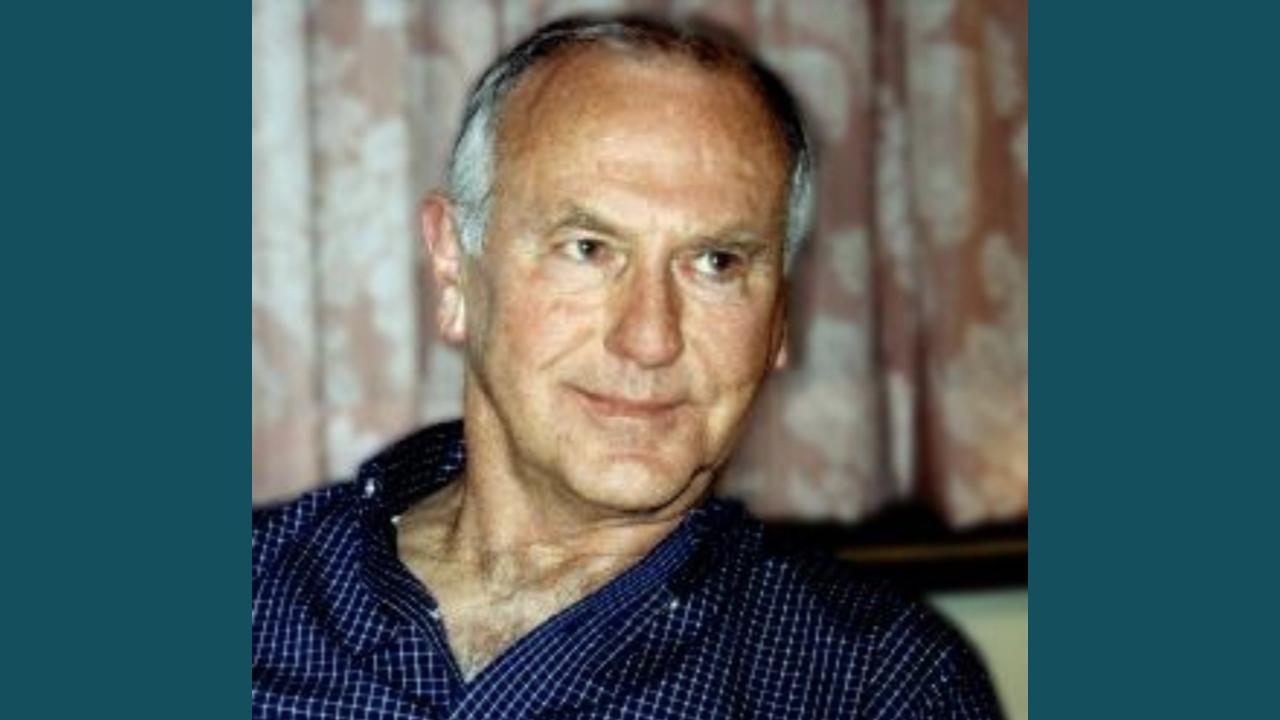
Summary
Walter Truett Anderson (born February 27, 1933) is an American political scientist, social psychologist, and author of numerous non-fiction books and articles in newspapers and magazines.
In his public lectures, he frequently speculates that, if we had a history of every advanced species in the universe, we would find that they all had to pass through two large, difficult and unavoidable transitions: accepting conscious responsibility for the future of all life on their planets, and recognizing that their systems of symbolic communication—such as language and mathematics—don’t merely describe reality, but participate in creating it.
Source: Wikipedia
OnAir Post: Walter Truett Anderson
About
Overview
Humans today are reconnected to each other for the first time since we left Africa to colonize the planet. At the same time, we are reaping the harvest of changes set in motion when the first single celled organism divided, observes Walter Truett Anderson. Embrace delight along with the discomforts we are all experiencing, he suggests, confident we are already quite different from our forebearers.
Walter Truett Anderson has spent a lifetime thinking and writing about and reporting on the rapidly accelerating changes of this era. He is president of the American Division of the World Academy of Art and Science. With a PhD in political science and social psychology, Dr. Anderson left academics to become an independent scholar and thinker. He is associate editor and columnist for the Pacific News Service and a founder and fellow of the future-focused Meridian Institute. His many books include All Connected Now: Life in the First Global Civilization, The Truth about the Truth, and Reality Isn’t What It Used To Be.
The exponential curve is the true symbol of our time, says Dr. Anderson. And he, unlike some others, is confident humans are capable of living in a multicultural, multidimensional world that is increasingly interconnected, where the rules do change in the course of our lifetimes and where we have to learn how to get along as members of multiple communities. He thinks we may even come to like what weâve become — global citizens.
Yes, there are profound implications to the reality that geography no longer constrains and defines us, Dr. Anderson acknowledges. Entire systems we used to think of as discrete — ecosystems that are political, economic, cultural and biological — are unstable, altering, being threatened and collapsing. Add in that there are now new connections between these systems, connections that simply did not used to exist. Each one of us is connected to all of these systems, he says, and they all interact.
“Globalization,” he assures us, is a lot bigger than economics. That one dimensional way of looking at it obscures what Dr. Anderson sees as a complex of responses on the political front. He suggests we expand the palette to include liberal and conservative globalists and anti-globalists, whose own boundaries are permeable.
Dr. Anderson is enthusiastically confident that we are up to the task of dealing with our changed reality. It is the specialty of humans to adapt, he reminds us. And the genuine leaders of the 21st century, he believes, will be people who embrace learning.
The emerging realities require us to define ourselves anew, Dr. Anderson counsels. The choices that 21st century humans have are not absolute and we may be wrong or unsuccessful. But, says Dr. Anderson, we each now have the freedom to declare, “This is the drama of which Iâm going to be a part. This is the role I’m going to take in that drama.” And he believes, in spite of the uncertainties, having these choices is wonderful. We do not get to be comfortable, he acknowledges. But we can be joyous.
postmodernizer & globalist. Dr. Anderson is president of the American Division of the World Academy of Art and Science, an associate editor and columnist for the Pacific News Service, and a founder and fellow of the future-focused Meridian Institute. With a PhD in political science and social psychology, Dr. Andersonâs many books include All Connected Now: Life in the First Global Civilization, The Truth about The Truth and Reality isn’t What It Used to Be.
Source: Paula Gordon Show
Web Links
On the Paula Gordon Show
Conversation 1 Walter Truett Anderson assures Paula Gordon and Bill Russell that rapidly accelerating change is now a fundamental reality of human life, human evolution and evolution in general. He shows how it fits into his multi-faceted definition of “globalization.” |
Conversation 2 The exponential curve is the best visual symbol of our time, Dr. Anderson says, and gives examples. He distinguishes one-dimensional ideas about globalization from what has been happening since homo sapiens departed from Africa to colonize the earth. For the first time since then, he points out, the entire human population is now reconnected. He describes what is happening as geographic constraints on human activity decline. He reminds us that the ideas of “a world” and of the human species as a biological unit are historically relatively recent, then revisits technologyâs central role in humansâ experience. |
Conversation 3 To be useful, we need to expand our concept of “globalization” beyond simply the economic, Dr. Anderson says, urging us also to include political, cultural and biological phenomena. Each, he says, is a system and all four systems are interrelated, with their boundaries unstable and collapsing. New and increasing connections between these systems affect us all — politically, economically, biologically and culturally already global citizens. He speaks to how these realities define and shape the kind of beings we are, humans living in the 21st century. He shows how fundamentally different we are today from people even a generation past. Demonstrably altered realities, however, do not decrease the power of the concept of “identity” for people, he says, even as the idea of nation-states withers. |
Conversation 4 Dr. Anderson reiterates the importance of accelerating change, offering a variety of ways to describe our current condition. He suggests different skills we must develop in order to function as multi-community people. He expands on how different sets of rules and expectations now shape all of our lives and argues forcefully that adapting to this new reality is entirely within our human capacity to adapt. He is confident, he says, that people are capable of living in a multicultural, multidimensional world that increasingly interconnects, where the rules change in our lifetimes and we learn to be members of multiple communities — and that we can even like it! He describes what a “leader” looks like in todayâs world, then explains why we no longer get to be “comfortable.” |
Conversation 5 Dr. Anderson draws a sophisticated map of contemporary global politics, using familiar left-right/globalist-anti-globalist descriptions. He gives a series of examples out of current political, economic, cultural and biological events. He offers examples of how everyone knows more than we think we know about what is going on in the world. He reiterates his belief in humans’ remarkable capabilities for learning and adaptation. |
Conversation 6 Reminding us that “culture” is only another way of describing the bath of information in which we all live, Dr. Anderson summarizes today’s world. He describes how much of his expanded idea of globalization has already come to pass and points out the irony of how global “anti-globalization” movements themselves are. He encapsulates the range of choices we humans have in the 21st century and marvels at opportunities those choices offer us all. |
Books
All Connected Now: Life In The First Global Civilization
Source: Amazon
Going beyond the narrow economic focus common to most books about globalization, All Together Now describes four kinds of global change – economic, political, cultural, biological – all of which are now accelerating, driven by the increasing mobility of symbols, goods, people, and non-human life forms. Anderson describes how we are entering an “age of open systems” as systems of all kinds – organizations, nations, ecosystems – change in similar ways.
Boundaries around systems are penetrated, challenged, renegotiated, relocated. Systems that were once relatively isolated develop new connections and linkages to other systems. Anderson argues that this globalizing world is radically “uncentralized” even though people and societies are richly interconnected. All Together Now shows how globalization is advanced even by anti-globalization movements, while global-scale problems such as climate change draw us together into the first global civilization.
More Information
Wikipedia
Walter Truett Anderson (born February 27, 1933) is an American political scientist, social psychologist, and author of numerous non-fiction books and articles in newspapers and magazines.
In his public lectures, he frequently speculates that, if we had a history of every advanced species in the universe, we would find that they all had to pass through two large, difficult and unavoidable transitions: (1) accepting conscious responsibility for the future of all life on their planets, and (2) recognizing that their systems of symbolic communication—such as language and mathematics—don’t merely describe reality, but participate in creating it.
Most of his major writing efforts have engaged one or both of these evolutionary themes. His defining statement on the first was To Govern Evolution: Further Adventures of the Political Animal. Its vision of human impacts on Earth’s life systems had been foreshadowed in his earlier book on American natural history, A Place of Power: The American Episode in Human Evolution, and was further developed in Evolution Isn’t What It Used To Be and All Connected Now. He is now at work on a new book that explores the evolutionary challenges and frontiers of the 21st century.
His major statements on the second (constructivist) theme were Reality Isn’t What It Used to Be and the subsequent anthology The Truth About the Truth. In other books on related subjects, The Future of the Self described changing ways that people are constructing personal identities in contemporary global society, and The Next Enlightenment points out the similarities between Western constructivist thought and Eastern spiritual traditions such as Buddhism.
He is currently President Emeritus of the World Academy of Art and Science (having served as president 2000-2008); a founding Fellow of the Meridian International Institute; a Fellow of the Western Behavioral Sciences Institute (LaJolla, CA); and a Distinguished Consulting Faculty member of Saybrook University in San Francisco.
In his book Radical Middle, author Mark Satin characterizes Anderson as a radical centrist thinker.[1]
Biography
Anderson spent his early years on his family’s cattle ranch in northeastern Nevada, but has also lived and worked in Germany, Spain, England, and Southern California. His undergraduate education was in political science at the University of California, Berkeley. Later, after military service and several years in magazine journalism, he began graduate studies part-time, completing a doctorate in political science and social psychology at the University of Southern California.
For most of his adult life he has been an independent author, lecturer and consultant. He has also taught part-time at various institutions including the University of California, Berkeley; Saybrook University; the California School of Professional Psychology; and California State University, Northridge. In the 1980s and 90s he was also a contributing editor with Pacific News Service in San Francisco, where he wrote many newspaper op-ed columns as well as investigative feature stories. He is on the editorial boards of several journals including The Journal of Humanistic Psychology, Futures: The Journal of Policy, Planning, and Futures Studies, The Journal of Futures Studies (Tamkang University, Taiwan), and Cadmus: The Journal of the South East Asian Division of the World Academy of Art and Science (Zagreb).
Books
- (2003) The Next Enlightenment: Integrating East and West in a New Vision of Human Evolution. St Martin’s Press.
- (2001, 2004) All Connected Now: Life in the First Global Civilization. Westview Press.
- (1997) The Future of the Self: Inventing the Postmodern Person. Tarcher/Putnam.
- (1996) Evolution Isn’t What It Used to Be: The Augmented Animal and the Whole Wired World. W. H. Freeman and Company.
- (1995) Ed. The Truth About the Truth: De-confusing and Re-constructing the Postmodern World. Tarcher/Putnam. (1996) Published in the UK as The Fontana Post-Modernism Reader. Fontana Press.
- (1990, 1991) Reality Isn’t What It Used To Be: Theatrical Politics, Ready-to-Wear Religion, Global Myths, Primitive Chic, and Other Wonders of the Postmodern World. HarperCollins.
- (1987) To Govern Evolution: Further Adventures of the Political Animal. Harcourt Brace Jovanovich.
- (1983, 1984) The Upstart Spring: Esalen and the American Awakening. Addison-Wesley. (2004) Republished as The Upstart Spring: Esalen and the Human Potential Movement: The First Twenty Years. iUniverse.
- (1983) Ed. Rethinking Liberalism. Avon Books.
- (1979) Open Secrets: A Western Guide to Tibetan Buddhism. Viking. (1989) Republished as Open Secrets: A Guide to Tibetan Buddhism for Western Spiritual Seekers. Tarcher.
- (1977) Ed. Therapy and the Arts: Tools of Consciousness. Harper Colophon.
- (1976) A Place of Power: The American Episode in Human Evolution. Goodyear/Prentice-Hall.
References
External links
- WaltAnderson.info Personal website hosted by The Authors Guild
- WorldAcademy.org The World Academy of Art and Science
- WBSI.org The Western Behavioral Sciences Institute
| International | |
|---|---|
| National | |
| Academics | |
| People | |
| Other | |


