Summary
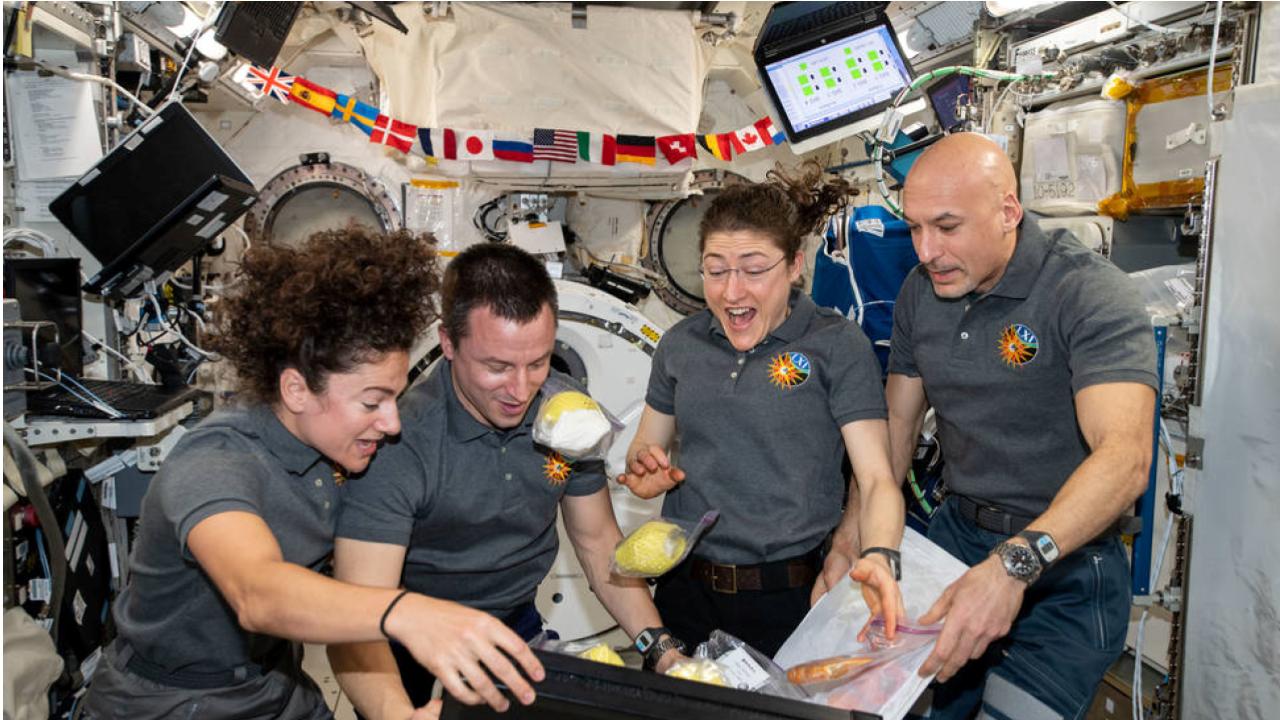
NASA’s “Living in Space” focuses on human spaceflight, including research on the International Space Station (ISS), and preparing for future missions to the Moon and Mars. The ISS serves as a microgravity laboratory for scientific research and a testbed for technologies needed for deep space exploration.
NASA’s goals include understanding how to sustain human life in space, developing technologies for long-duration missions, and fostering international collaboration.
OnAir Post: NASA – Living in Space
About
Web Links
Videos
Everything About Living in Space
October 14, 2016 (05:26)
By: NASA Johnson
With only five minutes but an unlimited number of questions, you can find out what it’s really like to live on the International Space Station—if you also have NASA astronaut Reid Wiseman, who spent 165 days in space during Expeditions 40 and 41 in 2014.
Listen as Wiseman answers the questions you would ask about real life in zero g: how big is the space station, is it very hot or cold there, was the food any good, did you prank-call anyone from orbit, and many many more.
HD download link: https://archive.org/details/TheSpaceP…
What Life Inside The International Space Station is Like
June 14, 2025 (13:30)
By: The Space Race
The Space Race is dedicated to the exploration of outer space and humans’ mission to explore the universe. We’ll provide news and updates from everything in space, including the SpaceX and NASA mission to colonize Mars and the Moon.
We’ll focus on news and updates from SpaceX, NASA, Starlink, Blue Origin, The James Webb Space Telescope and more. If you’re interested in space exploration, Mars colonization, and everything to do with space travel and the space race… you’ve come to the right channel! We love space and hope to inspire others to learn more.
Key aspects
Source: Gemini AI Overview 7/17/25
- The ISS is a major focus, with continuous human presence since 2000. Astronauts conduct research in various fields, including physical and biological sciences, and test technologies for future missions. The ISS also serves as a blueprint for global cooperation in space.
- Lunar Missions (Artemis):NASA’s Artemis program aims to return humans to the Moon for long-term scientific exploration and to develop the technologies needed for Mars missions. Artemis I was an uncrewed test flight, while Artemis II will be the first crewed flight.
- Living and working in low-Earth orbit and at the Moon are crucial steps in preparing for human missions to Mars.
- Technology Development:NASA is developing technologies for life support, food production, exercise, and overall well-being of astronauts in space. This includes systems for growing food (like the Veggie system on the ISS) and technologies for resource utilization on the Moon.
- Commercialization of Low-Earth Orbit:NASA is working with commercial partners to develop a robust space economy, including cargo resupply and crew transportation to the ISS and beyond.
Areas of research and development
Source: Gemini AI Overview 7/17/25
- Microgravity Research
The unique conditions of microgravity on the ISS allow for research that cannot be conducted on Earth.
- Human Health and Performance:NASA studies the effects of long-duration spaceflight on astronauts’ health and develops countermeasures to mitigate risks.
- Spacecraft Systems:NASA develops and tests technologies for spacecraft propulsion, life support, radiation protection, and communication.
- In-Situ Resource Utilization (ISRU):NASA explores methods for using resources available on the Moon and Mars, such as water ice, to support long-duration missions.
Open

